

Clomiphene citrate (often known by the brand name Clomid) was originally developed to treat infertility in women. Today it has an important off-label role in men’s health—as an oral option for raising testosterone while keeping the body’s own production switched on. For the right patient, it can be an alternative to traditional testosterone replacement therapy (TRT).
How Does Clomiphene Work?
Clomiphene is a selective estrogen receptor modulator (SERM). It works by gently blocking estrogen receptors in the hypothalamus and pituitary gland—the control centers in the brain that regulate hormones.
Normally, estrogen tells the brain to slow down hormone signaling. By blocking that “slow down” message, clomiphene makes the brain think estrogen is low. In response, it increases the release of LH (luteinizing hormone) and FSH (follicle-stimulating hormone), which then stimulate the testicles to produce more testosterone and support sperm production.
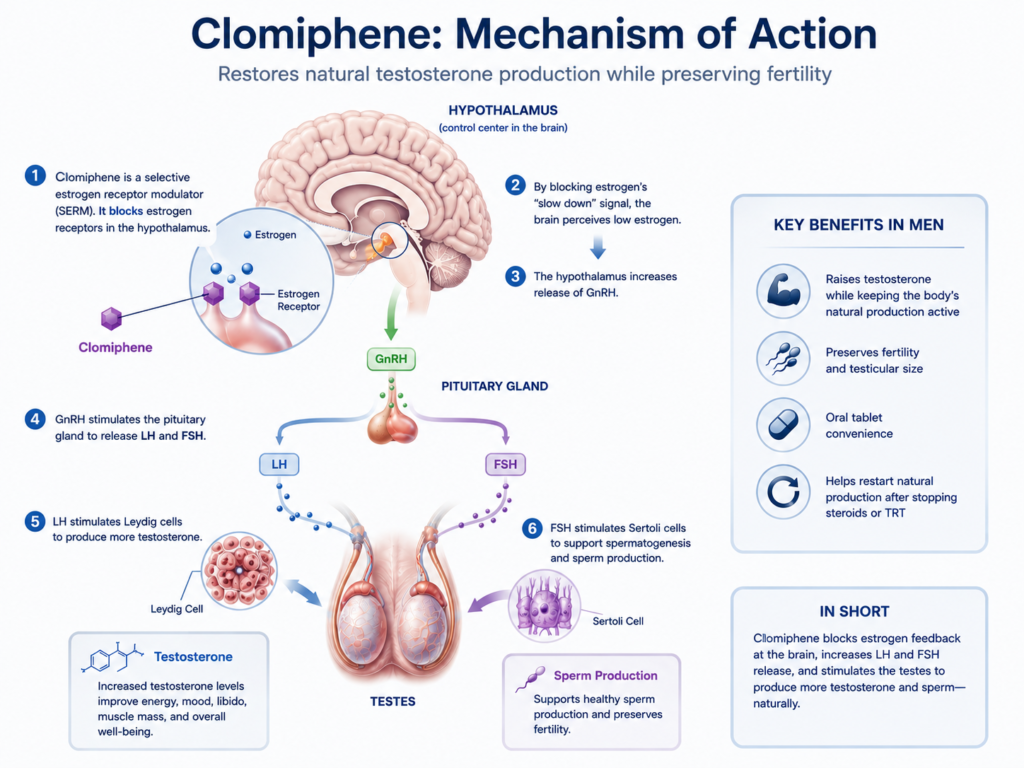 In short: instead of supplying testosterone from outside the body, clomiphene encourages your own testicles to make more.
What Is It Used For in Men?
- Low testosterone (secondary hypogonadism): Particularly useful for younger men whose low testosterone comes from a signaling problem rather than testicular failure.
- Preserving fertility: Because it keeps the natural LH/FSH pathway active, clomiphene maintains testicular size and sperm production—unlike standard TRT, which usually suppresses both.
- Men who want to avoid injections: It is taken as a tablet, making it a convenient option.
- Restarting natural production: It is sometimes used to help recover the body’s own testosterone after stopping anabolic steroids or TRT.
Why Choose Clomiphene Over TRT?
Traditional TRT is highly effective, but adding testosterone from outside the body signals the brain to shut down its own production. Over time this can cause the testicles to shrink and sperm count to drop—a concern for men who still want to father children.
Clomiphene offers a different approach:
- It raises testosterone while keeping the natural system working.
- It preserves fertility and testicular size.
- It avoids the need for regular injections, gels, or cream.
Dosing and What to Expect
Dosing is individualized, but a typical starting point is 12.5–25 mg daily or every other day, adjusted based on blood work and symptoms. Many men notice improvement in energy, mood, and libido within a few weeks, though full effects can take a couple of months.
Monitoring usually includes total testosterone, estradiol, LH, and/or FSH, so treatment can be fine-tuned over time.
Safety and Side Effects
Clomiphene is generally well tolerated in men. When side effects occur, they may include:
- Mood changes or irritability
- Visual disturbances (rare, and usually reversible if the medication is stopped)
- Headache
- Mild rise in estrogen levels in some men
Because individual responses vary, clomiphene should always be used under medical supervision with periodic blood tests.
Who Might Be a Good Candidate?
- Younger men with low testosterone who want to preserve fertility
- Men who prefer a tablet over injections
- Those with secondary hypogonadism (a brain-signaling cause rather than testicular failure)
- Men looking to restart natural production after stopping steroids or TRT
It may be less suitable for men whose testicles cannot respond properly (primary testicular failure), since the medication relies on a working testicle to do its job.
Final Thoughts
Clomiphene is a valuable, often underused option for men with low testosterone—especially those who want to protect their fertility or avoid injections. It is not the right fit for everyone, and the best choice depends on your hormone profile, your goals, and a proper medical evaluation.
If you’d like to know whether clomiphene is a suitable option for you, you are welcome to consult with our doctor at Transcend Clinic. A personalized assessment, including the right blood tests, ensures the safest and most effective plan.