

A man in his thirties or forties starts noticing the familiar list — flat energy, a libido that’s gone quiet, workouts that take longer to recover from. He gets his testosterone checked, finds it sitting low, and decides to try a short testosterone cycle to get back to normal: four, eight, maybe twelve weeks, often arranged informally rather than through an ongoing, monitored program. The plan is to feel better, then stop.
The problem shows up after the stopping, in two ways: natural testosterone production often doesn’t recover well, and even when it does, it only comes back to the same low level that caused the problem in the first place — not enough to hold onto whatever was gained while the cycle was running.
What Is a Testosterone Cycle?
In this context, a cycle means a defined period of taking testosterone — typically a few weeks to a few months — with a planned stop at the end, rather than an ongoing therapy that continues indefinitely under medical supervision. The term comes from bodybuilding and performance-enhancement culture, where cycling anabolic compounds for a fixed stretch and then stopping is standard practice. Applied to low testosterone, that same on-off pattern creates a very different problem: the person isn’t boosting an already well-functioning system; they’re interrupting one that wasn’t producing enough to begin with.
Why Your Body Pushes Back
Testosterone production runs on a feedback loop between the brain and the testes. The brain checks the testosterone level in the blood; when it’s adequate, the brain sends less of the signal (LH) that tells the testes to keep producing. When it’s low, the brain sends more.
Taking testosterone from outside the body — at any dose, for any length of time — is read by the brain the same way: levels are up, so the signal to produce more is dialed down. Natural production slows or stops for as long as the external source is in the system. This isn’t a side effect or a sign anything has gone wrong — it’s the feedback loop doing exactly what it’s built to do.
The same shutdown applies to FSH, the signal that drives sperm production, so sperm counts typically fall during a cycle too — something worth knowing for anyone who is planning to have children.
Recovery Isn’t Guaranteed
When the cycle ends, the external testosterone clears from the body within days to a couple of weeks. The brain’s own signal to restart natural production doesn’t come back on the same schedule — it was suppressed, and switching it back on can take months. In men who already had low or borderline testosterone before they started, that signal can be slow to recover, or in some cases doesn’t fully recover at all. A system that wasn’t producing well to begin with has less capacity to restart cleanly than one that was healthy to begin with.
Recovery also tends to be slower in older men and after longer or higher-dose cycles. Post-cycle therapy (PCT) — medications such as clomiphene or hCG — is sometimes used to help restart the system, but it helps production come back; it doesn’t raise it above where it started.
Even When It Recovers, It’s Not Enough
Even in the best case — full recovery of natural production — that recovery only brings a man back to the same testosterone level that was low enough to cause symptoms in the first place. Running a cycle doesn’t raise someone’s baseline; it raises levels temporarily, for as long as the external testosterone is being taken.
That matters because whatever was gained during the cycle — muscle, strength, libido, energy — was built and held up by that elevated level, not by the man’s own baseline. Once the cycle ends and testosterone settles back to the same low starting point, the system doesn’t have enough hormone to maintain those gains. They fade, often within weeks to a few months, back toward where things stood before the cycle began. The cycle doesn’t fix low testosterone — it rents a higher level for a while and hands the bill back at the original rate.
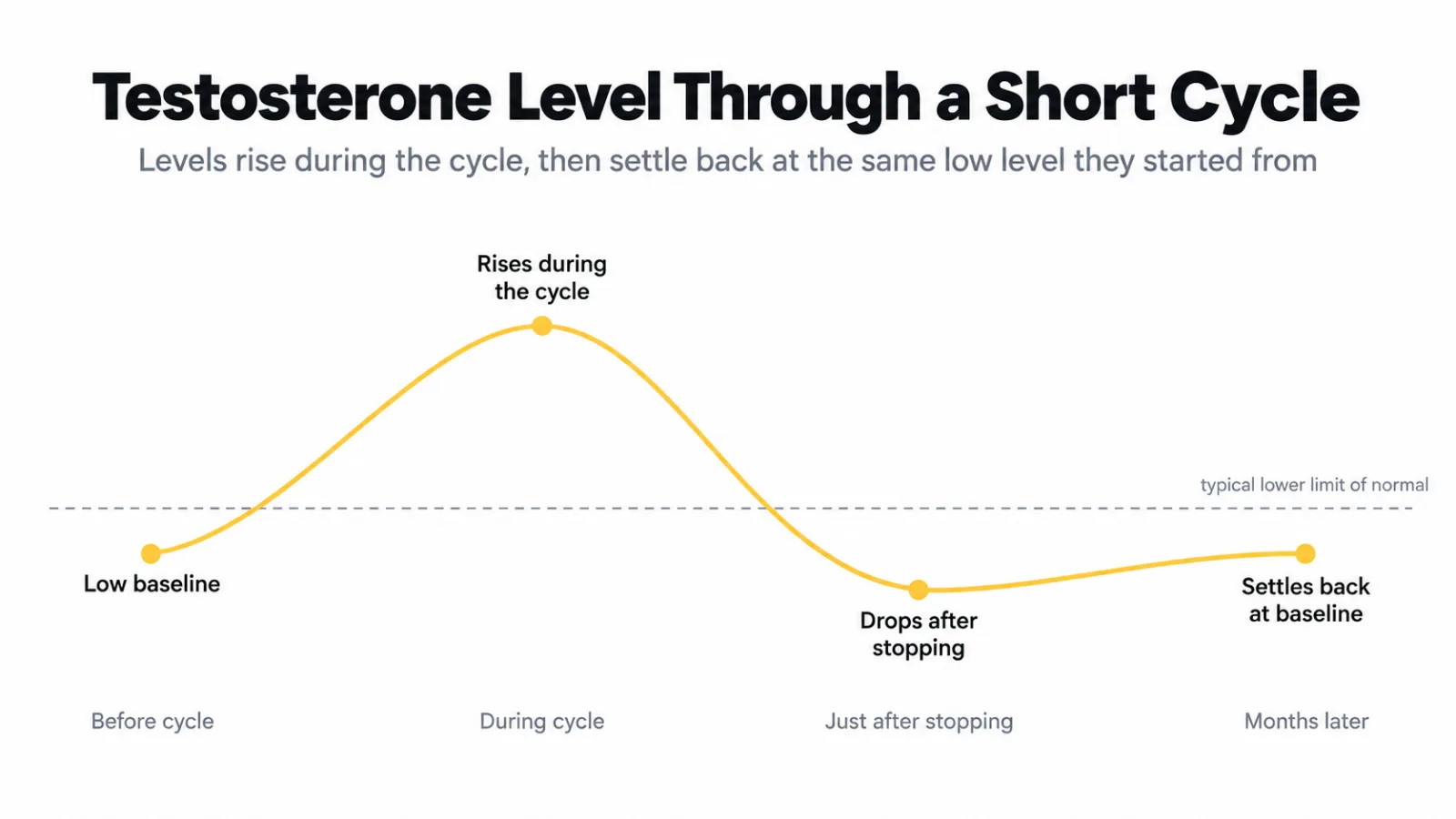 The level rises while the external testosterone is being taken, then falls back toward the same starting point once it’s stopped — never above it.
This is the core reason short, unsupervised cycles don’t work as a fix for low testosterone — they can’t outlast themselves. Diagnosed low testosterone is better addressed with an ongoing, monitored approach that keeps levels stable, rather than one that lets them rise and fall.
What Works Instead
Confirm the diagnosis first. A single low reading isn’t enough. Testosterone should be repeated on a morning sample, and interpreted alongside free testosterone, SHBG and LH — see what total, free and bioavailable testosterone each measure and why a total testosterone test alone isn’t enough to start TRT. LH also shows whether the problem starts in the testes or in the brain’s signalling, which changes the options.
Look for reversible causes. Excess body fat, poor sleep or sleep apnea, heavy alcohol use, certain medications and other medical conditions can all lower testosterone. Addressing these sometimes improves levels enough on its own.
If treatment is needed, treat it as ongoing. When low testosterone is confirmed and treatment is appropriate, testosterone therapy (TRT) works best as a continuous, monitored therapy — with regular checks of testosterone levels, hematocrit, PSA and other markers — rather than a fixed stretch with an end date. If someone isn’t ready for a long-term commitment, that’s a reason to hold off on starting, not a reason to cycle.
If fertility matters, consider other options. For men who want to preserve sperm production, treatments that stimulate the body’s own testosterone production — such as clomiphene or hCG — may be more suitable than testosterone itself.
Already Finished a Cycle?
If symptoms have come back — or got worse — after stopping, it’s worth checking testosterone and LH rather than starting another cycle. The results show whether natural production has restarted, and whether post-cycle support or a longer-term plan makes more sense. You can book a consultation to go through the results with a doctor.
References
- Bhasin S, et al. Testosterone Therapy in Men With Hypogonadism: An Endocrine Society Clinical Practice Guideline. J Clin Endocrinol Metab. 2018;103(5):1715–1744.
- Mulhall JP, et al. Evaluation and Management of Testosterone Deficiency: AUA Guideline. J Urol. 2018;200(2):423–432.
- Rahnema CD, et al. Anabolic steroid–induced hypogonadism: diagnosis and treatment. Fertil Steril. 2014;101(5):1271–1279.
- Kanayama G, et al. Prolonged hypogonadism in males following withdrawal from anabolic–androgenic steroids: an under-recognized problem. Addiction. 2015;110(5):823–831.