
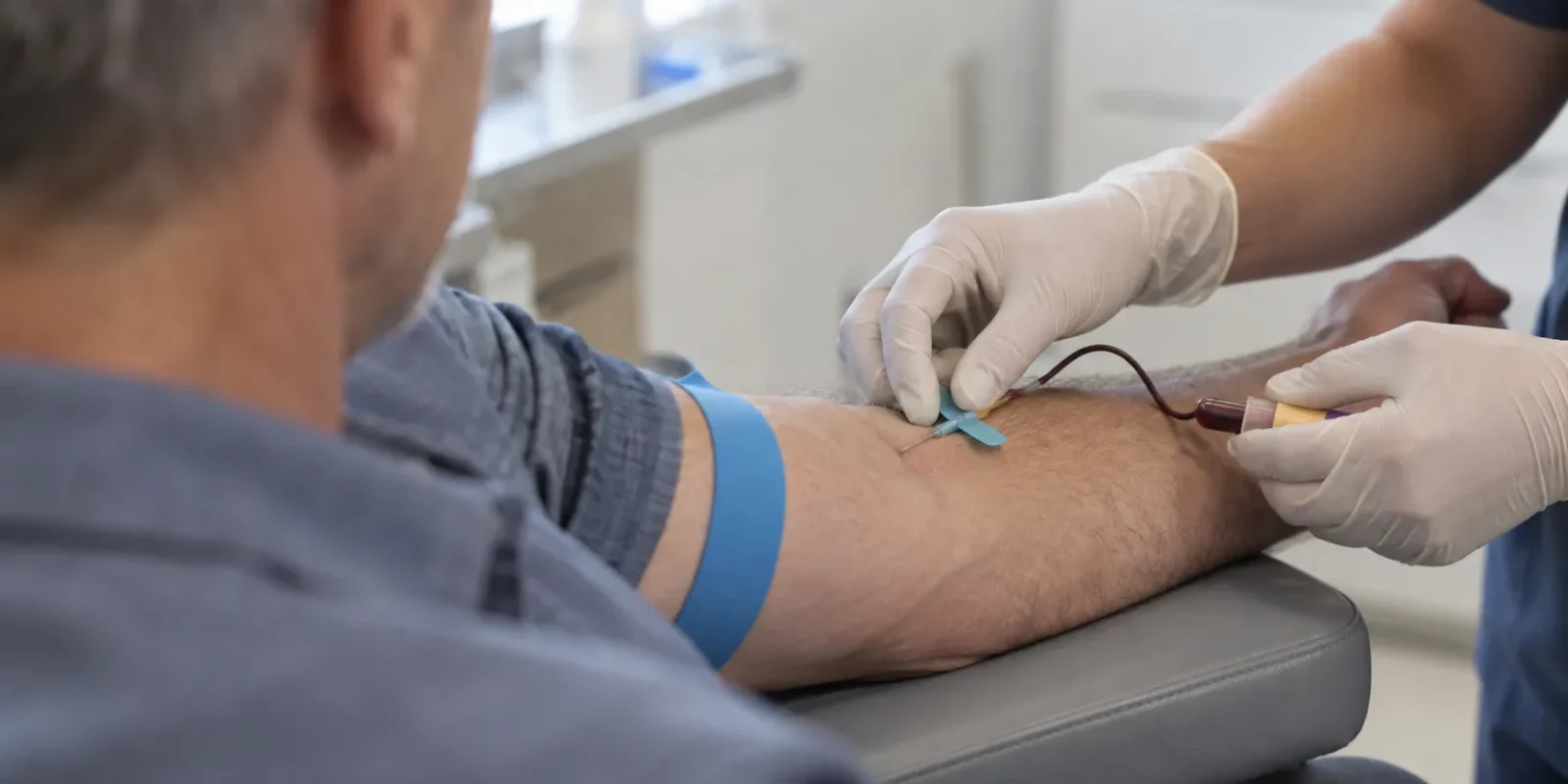
Many men are told their testosterone is normal on the strength of a single number, and the conversation stops there. That number is total testosterone, and it is only one of three values you can measure. On its own, it is often the least informative of the three.
The difference between free vs. total testosterone comes down to availability: how much of the hormone in your blood can actually reach a cell and do something. Bioavailable testosterone answers a similar question from a slightly different angle. Here is what each test measures, and when the distinction changes what happens next.
What Each Test Actually Measures
1. Total Testosterone
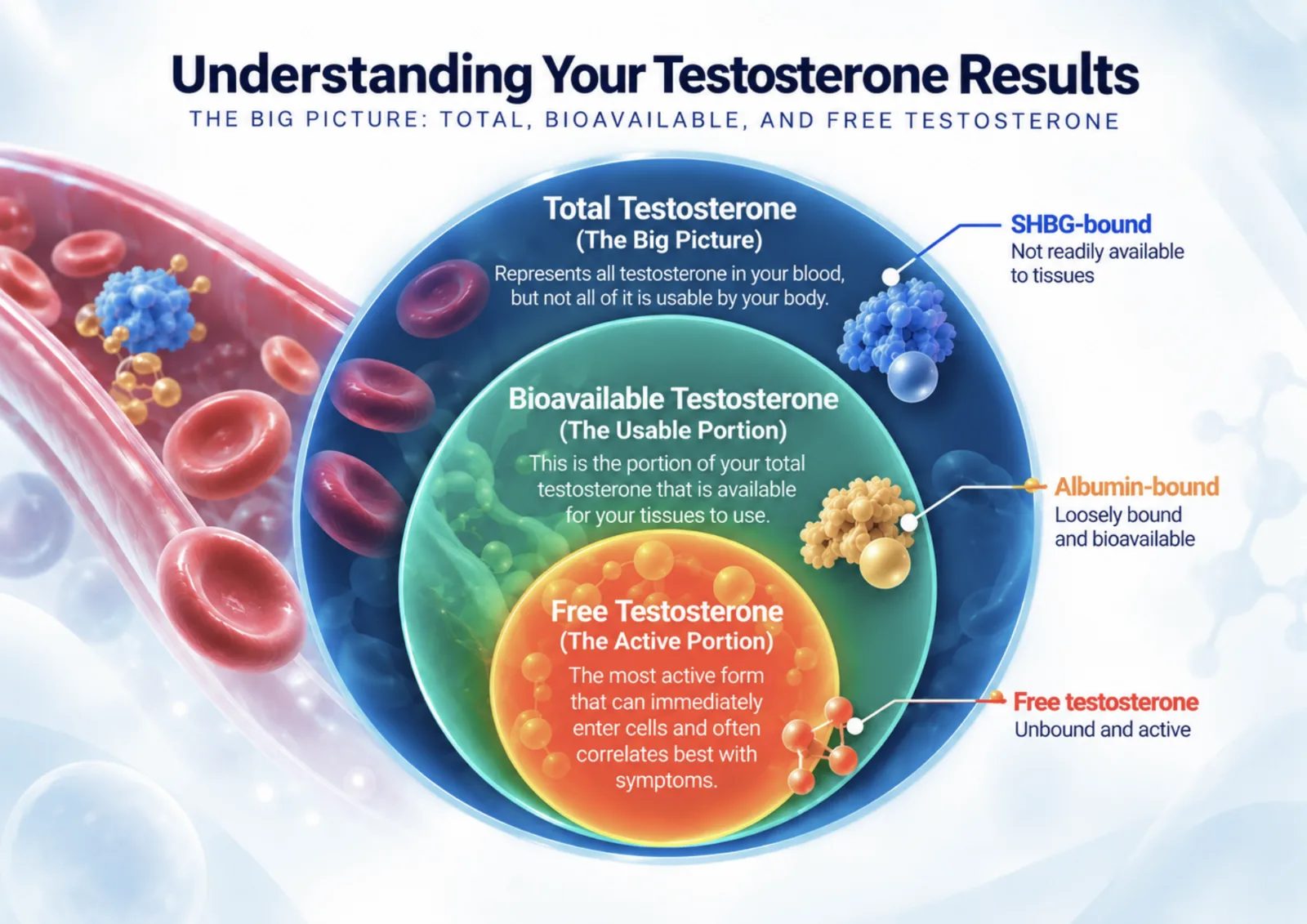
Total testosterone counts every testosterone molecule in circulation, bound or unbound. Roughly 40 to 60 percent of it binds tightly to sex hormone-binding globulin (SHBG), a carrier protein made by the liver. Another 30 to 50 percent binds loosely to albumin. Only 1 to 2 percent circulates completely free.
Total testosterone rolls all of that into one figure. It is the standard first test for sound reasons: it is inexpensive, well validated, and in most men it tracks overall production reasonably well. Timing matters more than most people expect, which is why we ask for a morning draw and cover the practicalities in our guide to getting an accurate testosterone blood test.
2. Free Testosterone
Free testosterone measures only the unbound fraction, the testosterone that can enter a cell and activate an androgen receptor immediately. It is the most biologically active measure, and also the hardest to measure well. Direct analog immunoassays for free testosterone perform poorly at the concentrations men typically sit at, and the Endocrine Society advises against relying on them.
Calculated free testosterone holds up far better. It derives the free fraction from total testosterone, SHBG, and albumin using a validated equation, most commonly the Vermeulen method. Equilibrium dialysis remains the reference standard when precision genuinely matters, though few laboratories run it routinely.
3. Bioavailable Testosterone
Bioavailable testosterone adds the free fraction and the albumin-bound fraction together. The logic is that albumin holds testosterone loosely enough that it releases at the tissue, so it still counts as usable. Laboratories generally measure it by ammonium sulfate precipitation, which removes the tightly SHBG-bound portion and leaves the rest.
In practice, bioavailable testosterone and calculated free testosterone move together closely. Most laboratories offer one or the other, not both, and either will answer the same clinical question.
Why Total Alone Can Mislead
SHBG varies widely between individuals and shifts with age, body composition, thyroid function, liver disease, and many common medications. Two men can return identical total testosterone results and have very different amounts of hormone reaching tissue, simply because one binds more of it.
That gap shows up in a few recognizable situations:
- Obesity and metabolic syndrome lower SHBG. Total testosterone falls along with it while the free fraction stays relatively preserved, so the total can overstate the problem. We covered this pattern in the vicious cycle of obesity and low testosterone.
- Aging tends to raise SHBG, which can hold the total up while free testosterone quietly declines, hiding a genuine deficiency behind a technically normal number.
- Thyroid disease and liver disease move SHBG in either direction, sometimes substantially.
- Symptoms that do not match the number. When a man has clear symptoms and a normal total, the free fraction is usually where the explanation sits.
A concrete version makes it clearer. Two men both return a total testosterone of 400 ng/dL. The first is 32, lean, with an SHBG in the middle of the range. The second is 58, with an SHBG at the top of the range. Run the calculation, and the older man’s free testosterone comes out well below the reference range, while the younger man’s sits comfortably inside it. Same total, different clinical picture, and only one of them is likely to feel well.
Which Test You Actually Need
For most men, a morning total testosterone, repeated on a second morning if the first comes back low, is the right place to start. That single result settles the question in most cases.
Free or bioavailable testosterone earns its place when the total does not settle it:
- Symptoms of low testosterone alongside a normal or borderline total
- A reason to suspect abnormal SHBG, such as significant obesity, thyroid disease, liver disease, or medications known to shift it
- A total sitting close to the edge of the reference range, where the result decides whether testosterone therapy goes ahead. This is the situation we wrote about in why a total testosterone test alone is not enough to start TRT.
Whichever you order, SHBG belongs on the same panel. Without it, you can’t calculate free testosterone, and you can’t interpret an unexpected result.
Conclusion
Total testosterone is a reasonable foundation. It cannot tell you how much hormone your tissues can actually use, or why a number looks the way it does when SHBG is unusual. A complete assessment generally includes:
- Total testosterone
- Free testosterone, calculated or measured by equilibrium dialysis
- Bioavailable testosterone, where your laboratory offers it in place of free testosterone
- SHBG
None of this replaces the clinical conversation. A result outside the reference range means little on its own, and a normal result does not rule much out when SHBG is unusual. These tests sharpen the discussion rather than conclude it.
If you are not sure which panel fits your situation, our health check-up includes a full hormone panel, and an online consultation can help you decide what is worth testing before you book bloods.
References
- Bhasin S, Brito JP, Cunningham GR, et al. Testosterone therapy in men with hypogonadism: an Endocrine Society clinical practice guideline. J Clin Endocrinol Metab. 2018;103(5):1715–1744.
- Vermeulen A, Verdonck L, Kaufman JM. A critical evaluation of simple methods for the estimation of free testosterone in serum. J Clin Endocrinol Metab. 1999;84(10):3666–3672.
- Goldman AL, Bhasin S, Wu FCW, et al. A reappraisal of testosterone’s binding in circulation: physiological and clinical implications. Endocr Rev. 2017;38(4):302–324.
Testing needs vary based on symptoms, medical history, and individual risk factors. Your doctor should interpret the results and recommend the appropriate next step.